Agent Memory Consolidation: Why AI Agents Dream
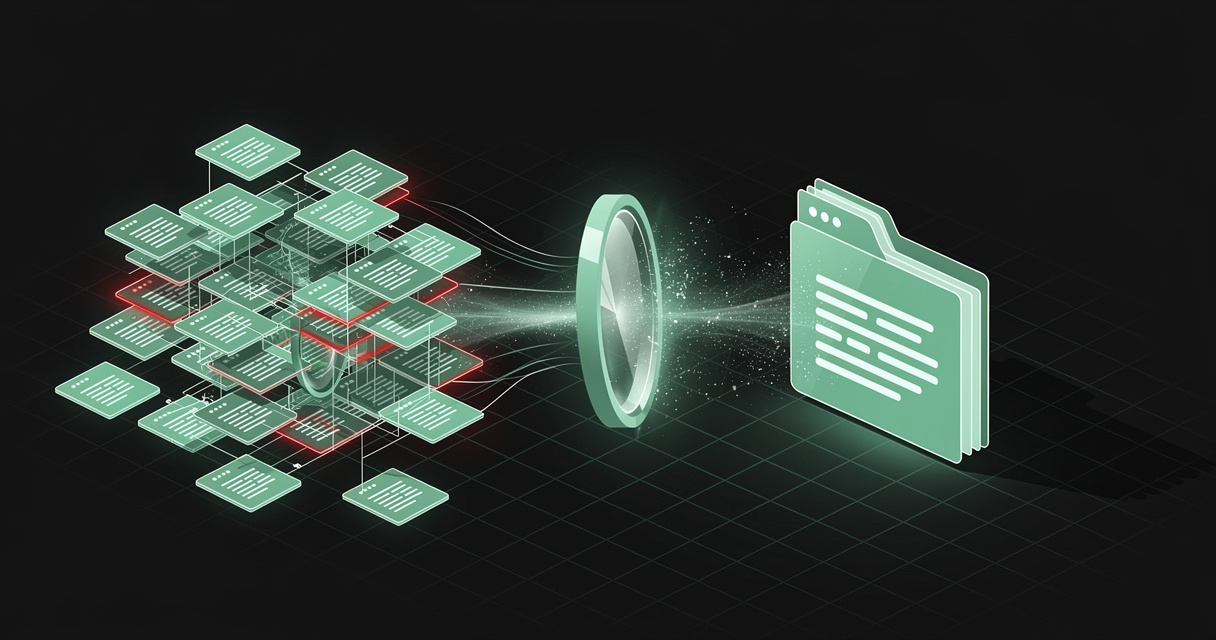
Give an AI agent a memory directory and it will use it. It will also, reliably, write things into it that are wrong — and then believe them for the rest of its life. That is the part nobody warns you about when they hand you the memory tool.
The fix is not a better prompt. It is a second pass, run later, when the task is over.
TL;DR — Agents write memory in-band, mid-task, under pressure to finish the current step. That writing is fast and sometimes wrong, and a wrong memory is read back as trusted fact forever. Agent memory consolidation is the offline pass that fixes it: re-read the store plus past transcripts, merge duplicates, resolve contradictions, prune the stale, and write down the generalisation instead of the one-off fact. Anthropic ships this as dreaming; the research literature calls it sleep-time compute. It only works if memory lives in a substrate the model can freely restructure — which is why plain markdown files, versioned, are the right shape. MDflow is exactly that substrate, readable and writable by any agent over MCP.
What is agent memory consolidation?
Agent memory consolidation is a second, offline pass over everything an agent wrote to memory during a task. It takes the memory store and the session transcripts as input, and produces a corrected, reorganised store as output: duplicates merged, contradictions resolved against what actually happened, stale entries replaced, and — the important one — one-off facts distilled into lessons that generalise to future sessions.
The framing that has stuck comes from Anthropic's Lance Martin, in a July 2026 talk on long-horizon tasks. Human memory has two subsystems: the hippocampus writes fast, experiential traces as you go about your day, and an offline process — sleep — consolidates the important ones into long-term cortical memory. Agents, he argues, need both:
| In-band | Out-of-band | |
|---|---|---|
| When | During the task | After the session |
| Optimises for | Finishing this step | Being right next time |
| Sees | The current context window | The whole store + past transcripts |
| Failure mode | Locally correct, globally wrong | Costs extra inference |
Concretely, a consolidation pass turns this:
memory/2026-07-14-session.md   "staging token is in STAGING_API_KEY"
memory/2026-07-19-session.md   "staging token is in env, not config.yaml"
memory/2026-07-21-session.md   "auth env vars are loaded in boot.ts"
memory/2026-07-22-session.md   "tried config.yaml for the token — wrong, use env"
…into this:
memory/conventions/credentials.md
  This service reads every credential from environment variables,
  loaded once in boot.ts. Nothing authentication-related lives in
  config.yaml — checking there has cost two sessions already.
Four episodic traces become one durable rule. That is the whole job.
Anthropic has since shipped the out-of-band half as a product primitive. In the Managed Agents API, a dream is an asynchronous job that takes one existing memory store plus 1 to 100 past sessions and produces a new memory store — "duplicates merged, stale or contradicted entries replaced with the latest value, and new insights surfaced." Crucially, the input store is never modified. You review the output and keep it or throw it away. It is a research preview, gated behind the dreaming-2026-04-21 beta header, and it is billed as ordinary tokens against whichever model runs the pipeline.
The academic version predates the product name. Letta's Sleep-time Compute (Lin et al., April 2025) moves reasoning off the user-facing critical path: the agent thinks about its accumulated context while idle, before the next query arrives. The reported result is roughly 5× less test-time compute for comparable accuracy on Stateful GSM-Symbolic and Stateful AIME, with accuracy gains of up to 13% and 18% respectively when the saved budget is spent instead.
Different names, one idea: the memory an agent writes while working is a draft.
Why in-band memory rots
Because a mid-task agent is optimising for the current step, not for the next session. Three distinct failure modes stack up:
1. Wrong writes persist as truth. Martin's demonstration is the one worth remembering. An agent playing Pokémon wrote an incorrect memory about its own location. That memory caused it to mislocalise, and it fell through the same trapdoor in five out of five runs. There is no natural decay — a bad memory is re-read at full confidence in every later session until something explicitly rewrites it. Run the dreaming pass over the trace and the error is corrected; the agent stops falling.
2. Locally optimal, globally useless. Mid-task the model records what unblocks it right now. Auth token for the staging box is in env var X is a true, useful, entirely disposable note. What you actually wanted written down was this codebase reads all credentials from env, never from config files. Martin's finding on this is sharp: the main thing separating a high-capacity model from a weak one at memory writing is the distillation step — knowing which abstraction, not which fact, will be useful later. Consolidation is where that distillation gets a second chance.
3. Accumulation. Over many sessions a store fills with near-duplicates and quiet contradictions. This is not just untidy — it is bounded. An Anthropic memory store caps at 2,000 memories with 100 kB (~25k tokens) per memory; hit the ceiling and new writes start failing. Anthropic's own remedy in the docs is to "run a dreaming session, which consolidates fragmented content into a separate new output store."
And there is a security edge. Memory stores attach read-write by default, and Anthropic's docs flag the consequence plainly: an agent processing untrusted input can be prompt-injected into writing malicious content that later sessions read as trusted memory. A consolidation pass that a human can review before promoting is one of the few places you get to catch that.
Why consolidation matters — for developers and for agents
For developers, consolidation converts memory from a liability into an asset:
- Failures stop repeating. The single highest-value output of a consolidation pass is the correction of a belief the agent has been acting on wrongly for weeks.
- Cost moves off the critical path. Sleep-time compute's whole argument: pay for thinking while idle, so the user-facing request is cheaper and faster.
- Memory becomes reviewable. A pass that emits a diff rather than a silent in-place update is auditable. You can read what your agent concluded about your codebase — and disagree.
- Growth stays bounded. Pruning is a first-class step, not something you do in a panic when writes start failing.
For AI agents, consolidation is where cross-session learning actually happens:
- Generalisation gets written down. In-band memory is episodic. Consolidation is where "this happened" becomes "this is how this system works."
- Retrieval gets cheaper. A store of 40 sharp files beats a store of 400 overlapping ones on every retrieval, at every context budget.
- Context stays small. Anthropic reports 39% improvement on agentic search and an 84% token reduction on a 100-turn web-search evaluation from pairing the memory tool with context editing. That maths only holds if the memory files are worth loading.
The substrate rule: do not prescribe a schema
The most actionable finding from the talk is about where memory lives, and it is a warning. Asked why a filesystem rather than a database, Martin's answer was that the substrate barely matters — what matters is that it is general and programmable with simple primitives the model can manipulate. A database is fine. What consistently fails is imposing a memory schema: pre-declaring the memory types the model is allowed to write.
Models can reason about their own memory and context structure much better than you can prescribe for them.
Classic bitter-lesson territory. Every rigid field you add is a place the model must file something that does not fit. This is also the reason consolidation can work at all: a dreaming pass rewrites structure, not just values — it renames, splits, merges, and reorganises. Give it a fixed schema and you have removed most of the moves.
Anthropic's own guidance points the same way: "Structure memory as many small focused files, not a few large ones." Not one big record. Many small documents, freely reorganisable.
Which describes a folder of markdown files almost exactly.
Which applications benefit most
- Long-horizon coding agents. Sessions measured in hours, across a codebase whose conventions the agent has to re-derive every time. Consolidated memory is the difference between an agent that learns your repo and one that rediscovers it. See the agentic coding loop.
- Support and customer-facing agents. Per-customer memory drifts fastest — preferences change, policies get superseded. Contradiction resolution is the whole job.
- Research and analysis agents. Findings accumulate across dozens of sessions, and the value is in the synthesis nobody wrote down: the pattern across findings, not the findings.
- Ops and on-call agents. Runbooks are exactly the artefact that goes quietly stale. An agent that touched an incident knows something the runbook does not.
- Org-level, multiplayer harnesses. Martin's fourth theme: agents are moving from single-player (your machine, your local config) to shared harnesses with organisational context and their own identity. A shared memory store needs consolidation, because many agents writing to one store is exactly how duplicates and contradictions get made. See team knowledge base for AI agents.
How MDflow fits
MDflow is the general, programmable substrate that consolidation requires — with the version history that makes it safe to run. The memory-store products above are excellent and vendor-bound: the store lives inside one platform, reachable by one API, readable by one company's agents. The substrate argument says the store should be plain, portable files. That is what MDflow is.
What already lines up today
Plain markdown, many small focused documents. MDflow stores documents markdown-native, in folders, with no proprietary wrapper — precisely the "many small focused files, not a few large ones" shape the guidance asks for. There is no memory schema to fit into, so a consolidation pass is free to split one document into three, merge three into one, or rename the lot.
Agents read and write it. Consolidation is a write-heavy operation, and MDflow's MCP server exposes real write tools: create, update, rename, move, delete, for both documents and folders. Claude and the ChatGPT app connect with an OAuth sign-in and no token to paste; Cursor, Codex, and Claude Code authenticate with a Personal Access Token. The same operations are available over the REST API, so the consolidation job does not have to be a chat session at all — see letting agents write to your knowledge base.
Version history makes the pass reversible. This is the part that matters most. Anthropic's dreams protect you by writing to a new store you can discard. MDflow gives you the same safety differently: every document carries automatic version history, so a consolidation pass lands as a reviewable diff. If the agent's "correction" was itself wrong — the failure mode the talk's own Q&A flagged as unresolved — you can see exactly what it changed and roll it back.
Folder descriptions are consolidated memory, in the retrieval path. Every MDflow folder carries a description stating what its documents are for, and mdflow_get_context ranks those descriptions above folder names and document titles when an agent asks about a topic — retrieval without a vector database. A description is the natural home for exactly the kind of distilled, generalising statement consolidation is supposed to produce, and rewriting it is one MCP call. Workspaces bucket the whole thing, so a consolidation job can be scoped to one client, product line, or agent.
Scheduling it is your call, not ours. MDflow has no built-in dreaming job — and deliberately so, because the substrate should not own the pipeline. Point anything at it: a cron job hitting the REST API, an n8n workflow on the community node, or a scheduled Claude Code / Codex run with MDflow connected over MCP. The prompt is the product: read this folder, merge duplicates, resolve contradictions against the transcripts, prune what is stale, rewrite the folder description.
And it stays portable. Every document has a raw .md twin any tool can fetch — this post included, at /blog/agent-memory-consolidation.md. Memory you cannot export is memory you have rented. Add sharing and collections for scoping what a team sees, the web clipper for capturing sources, and client-side encryption for the documents that need it.
Where we are headed
Direction, not a dated commitment: serving a whole collection to an agent as one cross-linked context bundle, so a consolidation pass sees a spec, its decision log, and its glossary together rather than as three retrievals; richer typed frontmatter so a document can carry freshness, owner, and confidence as structured signals a consolidation job can weigh; and tighter review round-trips for agent-proposed rewrites — the human approval step that makes a self-editing memory layer safe to leave running.
The bottom line
In-band memory is a draft. It is written fast, under task pressure, by a model optimising for the next step rather than the next session — and it does not decay on its own. Agent memory consolidation is the pass that turns that draft into something worth reading back: contradictions resolved against what actually happened, duplicates merged, one-off facts promoted into lessons that generalise.
The precondition is a substrate the model can freely restructure. Not a schema. Not a vendor's memory API. Plain, small, portable files — with a history, so a bad pass is a diff you revert rather than a belief you inherit.
Start free · Connect an AI agent · Read the API docs
Frequently asked questions
What is agent memory consolidation?
Agent memory consolidation is a second, offline pass over everything an AI agent wrote to its memory during a task. It reads the memory store plus past session transcripts, then rebuilds the store: duplicates merged, contradictions resolved, stale entries replaced, and generalisable lessons written in place of one-off facts. It is separate from the fast, in-band writing the agent does while it works.
What is dreaming in Anthropic's Managed Agents?
Dreaming is Anthropic's name for agent memory consolidation. A dream is an asynchronous job that takes an existing memory store plus 1 to 100 past sessions and produces a new, reorganised memory store — duplicates merged, stale entries replaced, new insights surfaced. The input store is never modified, so you can review the output and discard it. It is a research preview feature gated behind the dreaming-2026-04-21 beta header.
Why do AI agents write bad memories?
Because in-band writing happens under task pressure. Mid-task the agent optimises for finishing the current step, so it records what helps right now — locally correct, globally wrong. Anthropic's Lance Martin demonstrated this with an agent playing Pokémon: one incorrect memory about its own location made it fall through the same trapdoor in five out of five runs. A wrong memory does not decay on its own; it is read back as trusted fact in every later session until something rewrites it.
Should I give my agent a fixed memory schema?
Generally no. Martin's finding is that models manage their own memory better than a human-designed schema can, and that performance drops when you pigeonhole a model into prescribed memory types. What matters is a general, programmable substrate with simple primitives the model can manipulate — a filesystem of plain files is the common choice. Anthropic's own guidance is to structure memory as many small focused files rather than a few large ones.
How do I run memory consolidation over an MDflow workspace?
Point a scheduled agent at MDflow over the MCP server or REST API and give it the consolidation job as its prompt: read the folder, merge duplicates, resolve contradictions, prune what is stale, rewrite the folder description. Because MDflow keeps version history on every document, the pass lands as a reviewable diff you can roll back — and because the store is plain markdown, the agent restructures it with ordinary read and write tools rather than a memory-specific API.
Further reading
- Claude for Long-Horizon Tasks — Lance Martin, Anthropic (AI Engineer, July 2026) — the talk this post is built on: decoupling brain from hands, verifier loops, in-band memory, and dreaming.
- Dreams — Anthropic Managed Agents docs — the shipped consolidation primitive.
- Using agent memory — Anthropic Managed Agents docs — memory stores, limits, versions, and the read-only guidance for untrusted input.
- Memory tool — Claude docs — the client-side
/memoriesdirectory pattern. - Sleep-time Compute: Beyond Inference Scaling at Test-time — Lin et al., 2025.
- Effective context engineering for AI agents — Anthropic Engineering.
- MDflow: context engineering for AI agents, AI agent memory vs RAG vs a plain markdown file, build a portable AI memory you own, folder descriptions as agent context, and the MCP setup guide.