Team Knowledge Base for AI Agents: Shared & Versioned
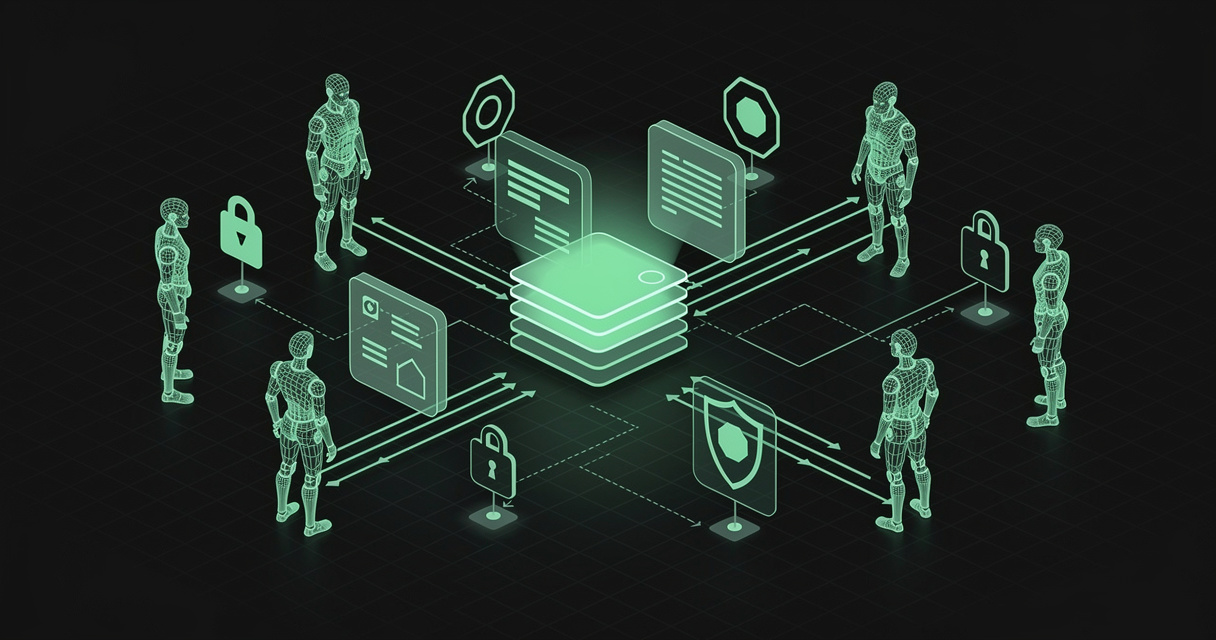
Solo AI-assisted work has a quiet dependency you stop noticing: the context lives in your head and your chat history. You know which document is the real spec, which decision is current, and why the API works the way it does — so when you prompt an agent, you fill the gaps automatically. The moment a second person and a second agent join, that dependency breaks. Their agent does not know what your agent knows. The "source of truth" is three Slack threads, a Notion page nobody updates, and two local notes.md files that disagree.
A team knowledge base for AI agents is the fix: one shared store of markdown that every teammate and every agent reads and writes, held together by two things a group cannot skip — access governance (who is allowed to see and change what) and version history (a record of how the knowledge changed). This post is about what that actually requires, and how to build one your agents can use today.
TL;DR — A team knowledge base for AI agents is shared markdown that people and agents both read and write, made trustworthy by governance and version history. Feature-local docs stay in your repos; the durable, cross-cutting knowledge — specs, decision logs, runbooks, standards, project memory — needs a shared home that is versioned and access-controlled. MDflow is built to be that home: agents read and write over a remote MCP server and an HTTP API, folder descriptions act as the retrieval layer, every change is version-tracked, and private sharing keeps sensitive docs restricted per person. Start free.
What is a team knowledge base for AI agents?
A team knowledge base for AI agents is a shared document store — in practice, plain markdown — that a whole team's people and AI agents can both read and write, governed by access controls and version history. It is the group version of a portable AI memory: instead of each person carrying their own context, the team keeps one canonical set of documents that any teammate or agent can retrieve and, where allowed, update.
Three properties separate a team knowledge base from a folder of files or a personal note store:
- Shared, not siloed. The same document answers the same question for everyone — human or agent — so there is one spec, one decision log, one runbook, not five drifting copies.
- Governed. Not everyone sees everything. Some documents are team-readable; some stay private; each shared item has an owner and an access level. Governance is what makes it safe to put real work in there.
- Versioned. Every change is recorded, diffable, and reversible. This is what keeps a shared store trustworthy — when many people and agents can write, you need to see who changed what and roll back a bad edit.
Plain markdown is the connective tissue. It is the format coding agents already read (AGENTS.md, CLAUDE.md, llms.txt, spec files), the format that renders cleanly for humans, and the format that carries no proprietary lock-in. A knowledge base your agents can use in 2026 is, overwhelmingly, a markdown knowledge base — markdown is the interface agents speak.
Why a shared, governed knowledge base is useful
For developers and teams
It ends the "re-explain the project every session" tax — for the whole team at once. A personal knowledge base stops you re-briefing your agent. A team knowledge base stops everyone re-briefing theirs, and stops teammates re-briefing each other. Concretely, a team gets:
- One source of truth. The current architecture decision, the live API contract, the on-call runbook — each exists once, and everyone (and every agent) reads the same version.
- Governed access. Sensitive material — security procedures, unreleased plans — is shared only with the people who should see it, while general docs are team-readable. The knowledge base can hold real work because access is controlled.
- An audit trail. When someone asks "when did we change the deploy process, and who?", the answer is a version diff, not an archaeology dig through chat history.
- No context drift. Because changes are versioned and reviewable, the shared context stays aligned with reality instead of quietly rotting the way an unversioned wiki does.
For AI agents
A governed, shared knowledge base gives every agent on the team the same high-quality context — and lets the good ones contribute back. An agent is a context engine: its output is only as good as what you feed it. Point a teammate's Claude, ChatGPT, or Cursor at the team knowledge base and it retrieves the team's canonical answer, not that person's partial notes. And because the store is writable, agents become producers, not just readers (more on that here): an agent can append a decision to the log, draft a runbook from an incident, or update a spec — with every write captured in history, so a human can review and, if needed, revert. That two-way loop is what turns a static doc dump into living team memory.
Which teams benefit most
- Engineering teams managing PRDs, architecture decision records, API contracts, and coding standards that many repos and many agents depend on — the durable specs that should not live in one repo.
- Research groups keeping shared literature notes, experiment logs, and decision rationale that both collaborators and analysis agents need to read consistently.
- DevOps and on-call teams maintaining runbooks and incident postmortems where an agent triaging an alert should read the current procedure, and versioning matters because the wrong (stale) runbook is dangerous.
- Product and ops teams keeping project memory — goals, constraints, glossaries, meeting decisions — that new teammates and their agents can absorb without a week of tribal-knowledge transfer.
- Consultancies and agencies juggling per-client knowledge where governance is non-negotiable: client A's docs must never surface in client B's agent context.
How MDflow fits
MDflow is a hosted, versioned markdown workspace that both humans and AI agents can read and write — with per-person sharing and full version history — which is exactly the shape of a team knowledge base for agents. Below is what you can build today, stated accurately, followed by where the product is headed.
What already lines up today
Markdown-native storage your agents already understand. MDflow stores documents as plain markdown — the same format your coding agents, specs, and instruction files already use. There is no export step and no proprietary wrapper between the document a teammate writes and the context an agent reads.
Folder descriptions are the shared retrieval layer. Every folder has a description that states what its documents are for. Describe an "API contracts" folder and a "Runbooks" folder accurately, and mdflow_get_context ranks those folder descriptions first when any teammate's agent asks for "the billing contract" or "the deploy runbook" — returning the right document body, not the whole workspace. It is shared retrieval without standing up a vector database for the team to maintain. Organize folders into workspaces to keep, say, each client or each product line in its own bucket.
Agents read and write over MCP and an HTTP API. This is the coordination surface. Over MDflow's remote MCP server, Claude and the ChatGPT app connect with an OAuth sign-in (no token to paste), while Claude Code, Cursor, and Codex authenticate with a Personal Access Token. An agent can pull the team's current context and write an update back — append to a decision log, draft a doc — so the knowledge base is a two-way collaboration surface, not a read-only archive.
Version history on every change — from every write path. A shared store is only trustworthy if you can see how it changed. MDflow captures the previous version on every saved edit across all three write paths — the editor, the API, and the MCP server — so when a teammate or an agent revises a shared spec, you can browse prior versions, view a line-by-line markdown diff, and restore any version non-destructively. That is the audit trail that keeps a multi-writer knowledge base from drifting. (Version history is a Pro feature.)
Governance through private sharing and comments. Share a document or a whole collection privately with specific people by email, choosing each person's access level — view only, or view and comment. Recipients open it under a "Shared with me" section after signing in; you can review who has access and revoke anyone's access instantly. Reviewers can attach comments to specific passages, so proposing a change to a shared spec is a conversation, not a silent overwrite. Sensitive docs simply are not shared — governance by default. (Private sharing by email is a Pro feature.)
Raw .md twins for reach. Append .md to a share link to get plain markdown with YAML frontmatter over open CORS — so any CI job, script, or agent that can fetch a URL can read a canonical team document by address.
Put together: your feature-local specs version in Git where they belong; your team's durable, cross-cutting knowledge — PRDs, ADRs, contracts, runbooks, standards, project memory — lives in one shared, versioned, access-controlled workspace, and the same mdflow_get_context call works from every teammate's Claude, ChatGPT, Cursor, or script.
Where we are headed
This is direction, not a dated commitment. MDflow today governs sharing per person on top of individual accounts; the roadmap points toward first-class team/organization workspaces — shared seats and roles so a group manages one knowledge base together rather than through per-document invites. Alongside that: email-based access control on collections so a whole curated set is granted to a team in one step, and serving a related collection to an agent as one cross-linked bundle (a system's PRD + ADRs + contract, retrieved together). The throughline is closing the loop from "every agent on the team reads the same governed context" to "agents help maintain it, under review."
The bottom line
The jump from solo to team AI work is not about a bigger model — it is about shared context that does not rot. A team knowledge base for AI agents is shared markdown that people and agents both read and write, made safe by governance and made trustworthy by version history. Keep feature-local docs in your repos. Put the durable, cross-cutting knowledge — the specs, decisions, runbooks, and standards many people and many agents depend on — in a shared home that is versioned and access-controlled.
MDflow is built to be that home: markdown-native storage your agents already speak, folder descriptions that act as a shared retrieval layer, read-and-write access over MCP and an HTTP API, version history on every write path, and private per-person sharing so sensitive docs stay restricted. Give your team and its agents one source of truth to build from.
Start free · Connect an AI agent · Read the API docs
Frequently asked questions
What is a team knowledge base for AI agents?
A team knowledge base for AI agents is a shared store of documents — usually plain markdown — that a whole team's people and AI agents can both read and write, with access controls that decide who sees what and version history that records how the knowledge changed. It gives every teammate and every agent the same source of truth (specs, decisions, runbooks, project memory) instead of context scattered across private chats and local files.
How is it different from a personal AI memory?
A personal AI memory serves one user's agent from one account. A team knowledge base adds the three things a group needs: governance (private sharing and per-document access so sensitive docs stay restricted), a shared retrieval layer (folder descriptions that tell any agent what a folder is for), and version history (an audit trail of who changed what, so the shared context does not silently drift). The knowledge outlives any single person's chat session and any single repo.
Can AI agents write back to a shared knowledge base, or only read it?
Both, if the platform allows it. MDflow exposes read and write over a remote MCP server and an HTTP API, so an agent can pull the current context and also create or update a document — for example, appending a decision to a log or drafting a runbook. Every write is captured in version history, so agent contributions are auditable and reversible, not silent overwrites.
Do we need a vector database to give a team's agents shared context?
No. MDflow ranks folder descriptions and document titles for a query and returns the best-matching markdown bodies through mdflow_get_context, so agents retrieve the right document without a separate embedding pipeline to build and maintain. For a small-to-medium team knowledge base, well-written folder descriptions are the retrieval layer.
How does version history prevent context drift for a team?
Every saved change to a document captures the previous version across all write paths — the in-app editor, the HTTP API, and the MCP server — so you can browse prior versions, view a line-by-line markdown diff, and restore any version non-destructively. When a teammate or an agent revises a shared spec, the diff is there to review, so the team's shared context stays trustworthy instead of quietly diverging from what people remember.
Further reading
- MDflow — Folder Descriptions as Agent Context · Letting AI Agents Write Back to Your Knowledge Base · Portable AI Memory You Own · Spec-Driven Development: Where Your Markdown Specs Should Live
- MDflow docs — MCP server · HTTP API · FAQ
- Anthropic — Model Context Protocol (the open standard MDflow's remote MCP server implements)