Human-in-the-Loop Automation Is Not the Goal
Think about the strongest domain expert on your team. The person sales pulls in to save an account, who owns the process nobody else fully understands. Now think about how their week actually goes: attention smeared across a dozen threads, loading up complicated situations, making decisions that look routine in hindsight. Only a sliver of that attention is left for moving the business forward.
The cost of raw white-collar output is cratering, and cheap execution does not relieve that expert. It makes things worse, because every unit of cheap execution still has to be decided about. Organizational judgment was already the scarce resource, and it is about to be scarcer.
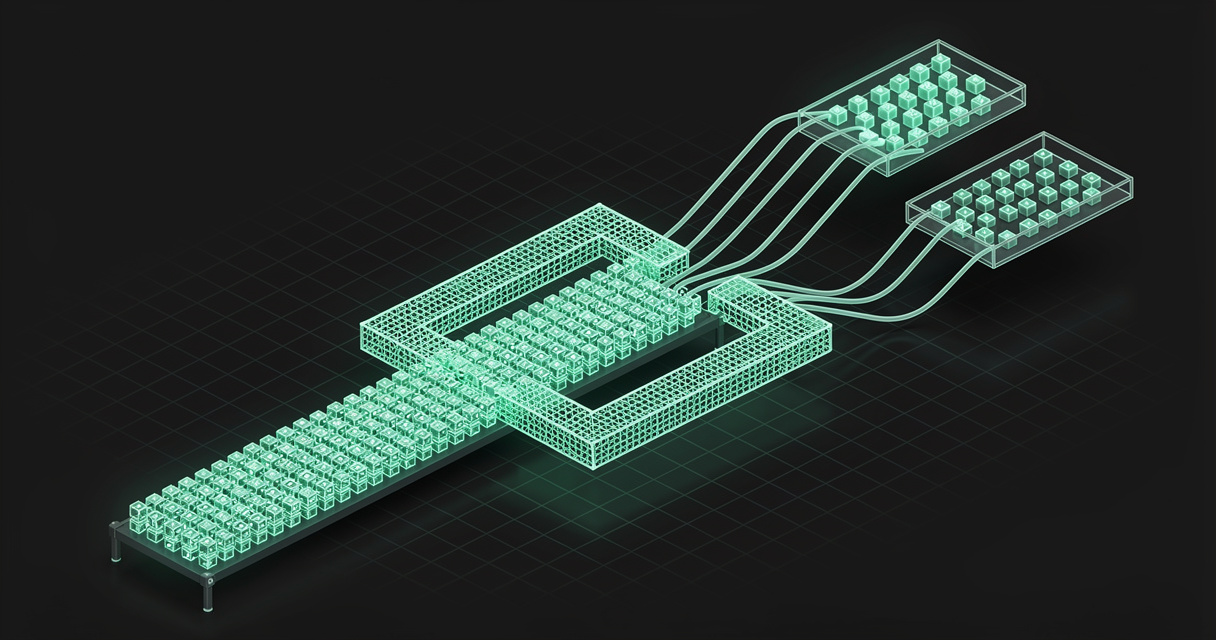
TL;DR — Human-in-the-loop automation keeps a person on the normal path, which means your best people spend their attention agreeing with a machine. Matthew Jewkes' argument is to engineer agency out of the happy path: build a full automation that takes an input and returns an output, and use AI judgment only at the edges, as a pre-filter that routes cases into lanes — ship it, harden it, decide it, escalate it. The routed-out cases are not waste; they are a sorted queue that organizes expert attention and surfaces where your market is moving. All of it depends on the lane definitions and the routed-out piles being written down somewhere both the people and the automation can read, which is what MDflow stores.
What is human-in-the-loop automation?
Human-in-the-loop automation is a design where the system stops on its normal path and waits for a person before continuing. The person is inside the loop, so throughput is bounded by their attention and every unit of work costs some.
It is worth separating three things that get called the same thing:
| Pattern | Who is on the normal path | What bounds throughput |
|---|---|---|
| Human-in-the-loop | A person, on every unit | Expert attention |
| Human-on-the-loop | Nobody, but a person watches | Expert attention, diffusely |
| Full automation | Nobody | The automation itself |
Matthew Jewkes of Standard Cybernetics, who by their own account previously ran MotionHall, a biopharma deal-enablement company whose assets Clarivate announced it was acquiring in March 2024, made the case for the third of these in an AI Engineer talk, Engineering Agency out of the Happy Path (November 2026). By full automation Jewkes means taking humans out of the happy path completely — using them for exceptions, but not in a human-in-the-loop style.
Why the happy path is the wrong place for a human
Because an automation that interrupts is an automation that keeps spending the resource you built it to protect.
Jewkes is explicit that agents expanded their sense of what software can do, and equally explicit that in an enterprise they come with problems: they are a pain to maintain, especially while skills and harnesses keep changing; they fail in unusually shaped ways that large organizations are bad at absorbing; and they increase the burden of decisions. Watching a senior expert answer agent notifications on their phone, Jewkes is suspicious that this is the best use of that attention.
Full automations have the opposite properties. They free attention rather than consuming it. They are legible: an input goes in, an output comes out, and the complexity is encapsulated where nobody has to think about it. And they are organizationally familiar — large organizations have been building automations in software for decades and in hardware for centuries, and they are one of the main tools by which organizations do bigger things.
That is a claim about organizational design, not about model capability. It is the same conclusion assistance versus automation reaches from the other end: when nobody is checking the output, the judgment has to be in the system rather than in a reviewer. This post is about what that system looks like when you build it as the architecture instead of the fallback.
The one place agency belongs: the escape hatch
There is one genuinely good use for agency inside a full automation, and it is at the entrance rather than in the work.
Everyone has met the failure it prevents: you sign up as a vendor and receive the whole marketing drip, because the automation matched a shape it should have rejected. So put a model at the door and let it ask whether this task actually belongs on the happy path. Reject adversarial inputs. Notice when something looks business-critical rather than routine, and escalate it before the pipeline touches it.
Jewkes frames this precisely: this is using AI agency to reduce the variance of an automation, which is what lets you widen the set of things you are willing to automate at all. Agency is not the worker. It is the gate.
The four lanes a router actually sorts
The case study is document indexing at Clarivate, which holds an annotated history of the drug development industry: tens of millions of documents, hundreds of thousands of edits a year, a rich ontology and tens of thousands of ways of indexing it. The automation handles the indexing and the relationships between those documents, processing tens of thousands of new tasks a month as documents are edited or inserted.
The first build, begun around 2024, looked like what we would now call a research-and-assignment agent. After a few sprints it hit 80 to 83 percent — genuinely exciting to a team used to spending months fine-tuning a single model for one component of one pipeline.
Then they compiled a thousand evals and sat down with domain experts. One process note from that step is worth stealing on its own: do not hand a busy expert a blank spreadsheet and ask for a hundred evals. Bring them a pile of real failures instead. It builds momentum, it gets the experts fixated on exactly the cases that matter, and it teaches a skill — writing evals is an art — by example. (Domain expert evals is the longer argument for putting the definition of correct in the practitioner's hands.)
What the evals revealed was not one accuracy problem but three different kinds of case, mixed together:
- Critical errors. A small bucket where everyone agreed a misstep would threaten material accounts. Even top models fail 2 to 3 percent of the time on multi-step workflows, sometimes irreproducibly, and at scale you see every bit of it.
- Organizationally undecided cases. A large bucket where two experts might confidently disagree, or where the organization had never actually decided. By Jewkes' estimate this ran to something like a fifth of all tasks.
- Exceptions. Roughly 3 to 5 percent that needed genuine human attention because they were new.
The undecided bucket is the one most teams misdiagnose, so it is worth a concrete example. In drug development, a target is the pathway or molecule a drug acts on. Gout flares are driven by monosodium urate crystals activating the NLRP3 inflammasome, which releases interleukin-1 beta. Colchicine treats gout, and it binds tubulin — disrupting microtubules, which interferes with inflammasome assembly and lowers IL-1β release downstream. So: does colchicine target IL-1β?
Ask two frontier models and you can get two different answers, and each will flip on re-asking. That is not a model defect. The molecule colchicine binds and the molecule whose suppression makes it work are two different things, and whether the second counts as a target is a question about your indexing convention rather than about the pharmacology. There is no label to grade against because nobody has agreed one.
The third bucket looks different again. Jewkes showed a new cardiovascular candidate — by the name given on stage, Verve Therapeutics' VERVE-102, an in vivo base editor that inactivates PCSK9 to lower LDL cholesterol — where, on Jewkes' account, four of the six mechanism entries the system needed to index were new to science. There is a decidable answer, but reaching it means a human updating ontologies and relationships. That is an escalation, not an error.
So the routing comes first, and Jewkes reckons the team spent at least as much time building case routing as on the final accuracy climb. Is the model confused, or does this look unusual? Abort, have the model describe what it saw, categorize it away. Is it plausibly business-critical? Send it down the heavily evaluated pipeline, and if that pipeline is still unsure, return it to a human as an exception. Is it undecided? Pipeline it out too. Everything else — the large majority — ships.
With the ambiguous and exceptional cases removed, standard approaches reached about 95 percent on what remained. Getting from there to what Jewkes calls three and a half nines, 99.95 percent, was a long hill climb: reading evals, one trick at a time, nothing glamorous. Deployment waited until a random sample showed the system beating the historic human work, and the claim is that it then performed better than PhD-level humans at scale — with the honest qualifier that a PhD sitting with a single case and all its details will still win, just not across hundreds of cases a week under fatigue and time pressure.
The exhaust is the product
Here is the part that is easy to miss, and it is the most valuable idea in the talk. Those routed-out lanes are not a dumping ground. They are the automation's second output, and the one that compounds.
Because you invested so heavily in routing, your expert no longer gets a stream of notifications. They get three organized piles.
The critical-but-uncertain pile is tiny by construction. They review it quickly and ship.
The undecided pile is more interesting than it looks. The instinct is to use it to pressure the organization into specifying. But often these cases are unspecified precisely because they are only marginally valuable — and specifying them is expensive. Seeing the whole pile at once lets an expert make the opposite argument with evidence: freeze this work, deprioritize it, stop thinking about it until there is a business case. Removing things from the organization's attention is a real form of reducing complexity.
The exceptional pile is where the compounding happens. Groundbreaking work is maybe 3 percent of drug development; the rest pattern-matches. An expert encountering one novel case every week or two cannot build intuition about it — too sporadic to price, too scattered to prioritize, impossible to justify an investment against. Aggregate those same cases into a pile and sit with them for two or three hours, and patterns appear. Jewkes watched this happen on an eight-figure account: by the time the customer raised the problem, the expert had already formed an opinion about where to invest, because the data was already structured.
Generalize it and the exception pile is a leading indicator. In any scaled business process, the cases that fall off the happy path are where the market is moving — they just arrive too infrequently to read as signal. Organize the exhaust and your best people can think about it.
That is the actual payoff, and it is organizational: hours saved, task-level quality up, a whole category of work encapsulated so nobody thinks about it, and senior attention routed toward higher-value problems. Jewkes calls it organizational refactoring.
Where not to do this
Full automation at this quality level is expensive, and the talk is unusually honest about it. It is a CAPEX project: AI engineers are not cheap, and having one spend hours reading a spreadsheet of evals is not cheap either. Going from 95 to 99.95 percent is its own budget line. If you are refactoring a non-engineering process you also inherit organizational change, trust building and ownership change.
So pick deliberately:
- Not in a startup, and not in discovery. Keep the flexibility of humans while you are still learning what the process is.
- Not for subjective, judgment-laden work. That is where the line sits, and Jewkes' view is that automating the one differentiated process your business is built around is still not where the action is.
- Yes where there is scale and material ROI. A bucket of tasks attached to seven figures of revenue, with customer tickets saying the current state hurts, is something a CFO can evaluate.
- Yes where written specifications exist — and do not worry much about whether they are any good. Specifications are hard, and the mere fact that someone tried to write them signals that the team believes the work is specifiable rather than raw judgment.
- Yes for detail-oriented rote work at expert level. Doing PhD-level rote work is genuinely new, and it is exactly the work humans fail at under volume.
Which applications benefit most
- Classification and enrichment over a large corpus — indexing, tagging, entity linking, ontology maintenance, where volume is high and each decision is small.
- Document-driven back office — claims intake, invoice and contract processing, compliance checks against a written standard.
- Ticket and request triage — routing by whether the request matches a known path at all, which is the escape hatch applied as the whole product.
- Data quality and reconciliation — the recurring checks that consume analyst hours and produce an answer nobody enjoys deriving.
- Regulatory and scientific curation — where an ontology exists, the inputs are structured, and novelty genuinely needs a human.
- Any process whose exceptions are commercially interesting — because there the exhaust pile justifies the build on its own.
How MDflow fits
What already lines up today
The architecture above has a documentation dependency that is easy to overlook. A router needs a written definition of each lane, and a pile of routed-out cases is only reviewable if the cases land somewhere a person can actually read in aggregate. Both of those are documents, not code.
MDflow stores plain markdown in folders, and each folder carries a description that states what belongs in it. Those descriptions are the primary ranking signal for topic retrieval — mdflow_get_context ranks folder descriptions above folder names and document titles — so the four lane definitions can live as four folder descriptions that an agent fetches when it needs them, rather than as prose pasted into a prompt that drifts out of date. A document also exposes its full path and its compounded description, the workspace-to-folder cascade, which is the context that tells a model what kind of pile it is looking at. Folder descriptions as agent context covers that mechanism in more detail.
On the write side, the automation can file a case itself. The remote MCP server and the HTTP API both create and update documents with a Personal Access Token or an OAuth connection, so "route this case into the undecided folder with the model's description of why" is one call. Be clear about what that token is, though: an mdf_ Personal Access Token is account-wide and read-write, with no read-only mode and no per-workspace scoping. Only Team tokens are scoped.
A few more pieces fit the review half:
- Writing the decision down closes the loop. When the organization finally decides a contested case, the decision belongs in the folder description or a decision document, so the next run retrieves it instead of re-guessing. Every write path is captured in version history, including writes made by the API and the MCP server, so an agent's own edit leaves the previous version behind.
- Comments are the annotation surface. On a shared document, a reviewer can attach a comment to a specific passage and the owner can moderate from the normal editor — useful for arguing about a disputed case in place. This is a personal-sharing feature; Team documents deliberately omit comments for now.
- The eval set and the failure notes are documents too. A thousand evals plus the notes on why each failure happened is a corpus, and it is more useful to the next engineer as readable markdown in a described folder than as rows in a spreadsheet nobody opens.
Two honest limits. Version history is a Pro feature, is private to the document owner in the personal case — active Team members can compare and restore Team documents — and is bounded to 30 days or 300 versions, whichever comes first; more importantly, it is not exposed over the HTTP API or MCP, so an agent cannot ask what changed since its last run. And raw .md twins with frontmatter exist for shared pages, not for every private document.
Where we are headed
The direction, not a dated commitment: more of the retrieval surface reachable by agents without a human assembling a prompt, and more of a document's own history legible to the thing that wrote it. A router that can read when a lane definition last changed, and an expert queue that an agent can append to and a person can triage, are the same feature viewed from two ends. If your automation writes its exhaust into MDflow today, those are additive improvements to a pile you already have rather than a migration.
The bottom line
Human-in-the-loop automation is not a safety property. It is a throughput ceiling, and it spends the one resource that is getting more expensive. The alternative is not a more autonomous agent on the same path — it is a full automation with nobody on the happy path, a model at the door deciding what belongs there, and three organized piles for the cases that do not.
Jewkes closes on a line paraphrased from Rockefeller: as soon as you can, hire someone to do your job, then sit down and think about how to make the company more money. If your job is specifiable, get it done by something else. The closing bet is that orchestration software will not be the differentiator in 2026, and that the companies that win with AI will be the ones that best manage their collective attention and judgment.
Managing attention means organizing what reaches it. That is a writing problem before it is a modeling problem.
Start free, connect an AI agent, or read the API docs.
Frequently asked questions
What is human-in-the-loop automation?
Human-in-the-loop automation is a design in which an automated system pauses on its normal path and waits for a person to review, confirm or correct each unit of work before it continues. The person sits inside the loop, so throughput is bounded by their attention. It is distinct from human-on-the-loop designs, where the system proceeds and a person monitors, and from full automation, where the system takes an input and produces an output with nobody on the normal path at all and people handle only the cases routed out of it.
Is human-in-the-loop automation bad?
No, but it is often the wrong default for work that runs at scale. Keeping a person on the happy path means every unit of work consumes expert attention, including the large majority of units where the expert will simply agree. Matthew Jewkes argues in an AI Engineer talk that the better pattern for a scaled, specifiable process is to remove humans from the happy path entirely and reserve them for exceptions, because this both frees attention and makes the automation legible as a single encapsulated step. For small volumes, discovery work, or subjective judgment, keeping the human in the loop is still correct.
What is an organizationally undecided case?
It is a case where the automation is not wrong because the model failed, but because the organization itself has never decided the answer. Two qualified experts can confidently disagree on it. Jewkes found a large bucket of these when the team sat down with domain experts over a thousand evals. They cannot be fixed by better prompts or more evals, because there is no agreed label to train or grade against. They have to be routed out of the pipeline and decided, or explicitly frozen.
How accurate can a fully automated AI pipeline get?
Jewkes reports that once ambiguous and exceptional cases were routed out, standard approaches reached roughly 95 percent on the remaining business-critical tasks, and sustained hill-climbing on evals took that to what the talk calls three and a half nines, or 99.95 percent. Jewkes presents this as achievable for most automations where inputs are well structured and the specific set of cases has been articulated from the business, and as expensive engineering work rather than a property of the model.
Where should the routing rules and the routed-out cases live?
In documents that both the people and the automation can read, rather than only in code or prompts. The lane definitions are a written classification spec, and the routed-out cases are piles an expert reviews in aggregate. A markdown workspace such as MDflow fits because folder descriptions are the primary retrieval signal for topic lookups, so an agent can fetch the current definition of a lane instead of carrying a pasted copy, and it can write a case into the right folder over the MCP server or the HTTP API.
Further reading
- Matthew Jewkes, Engineering Agency out of the Happy Path — the AI Engineer talk this post is built on (November 2026).
- Clarivate, Clarivate acquires AI start-up to accelerate strategy and business development success — the March 2024 MotionHall announcement.
- Colchicine — update on mechanisms of action and therapeutic uses — the review identifying tubulin disruption as colchicine's primary mechanism.
- Verve Therapeutics, VERVE-102 — the base-editing programme named as the escalation example.
- Assistance vs Automation: Why AI Feels Jagged — why unattended work breaks when the reviewer is absent.
- Domain Expert Evals: Who Decides What Good Means — putting the definition of correct in the qualified practitioner's hands rather than the engineer's.
- The Agent Autonomy Ladder — the complementary pattern, promoting one action at a time on evidence.
- AI Agent Approvals: Approve the Job, Not the Step — what to do when a human genuinely must authorize.
- MDflow MCP documentation, the HTTP API reference, and the FAQ.